Why Do You Call Tiny Homes the, “most desired, most successful, and most affordable” solution?

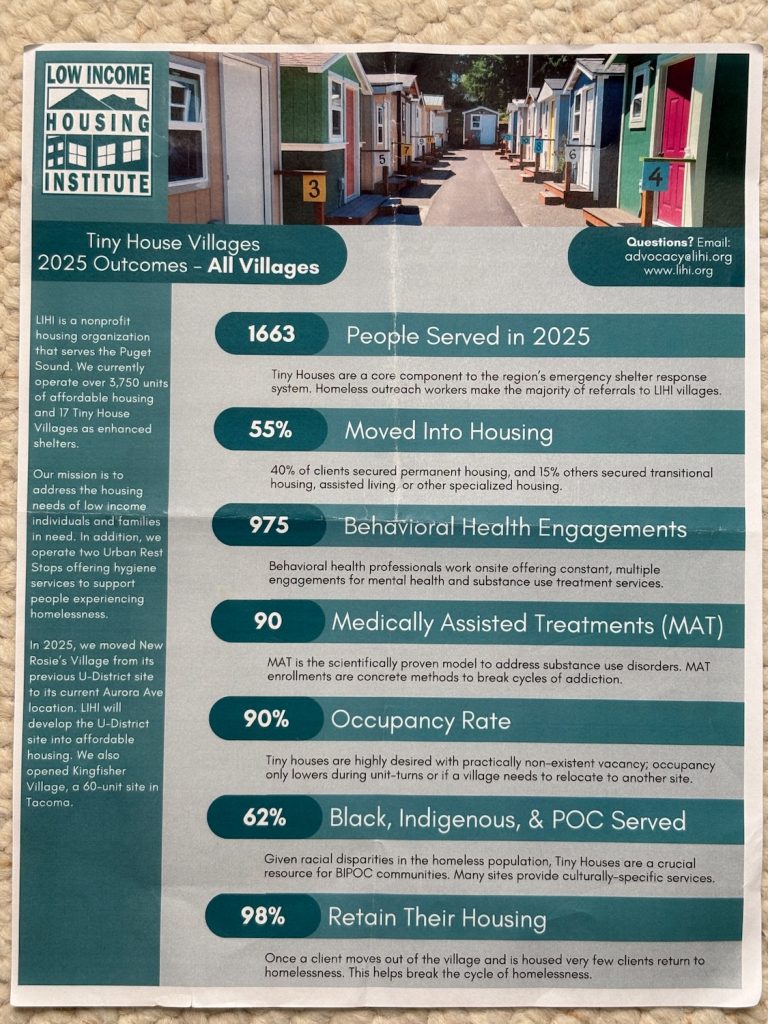
Since most of the tiny home villages in our area are run by the Low Income Housing Institute (LIHI), and most of the tiny homes in LIHI’s villages are built by Sound Foundations NW, we rely on the annual data they produce regarding outcomes for their tiny home villages to evaluate our homes’ performance.

Most Desired …

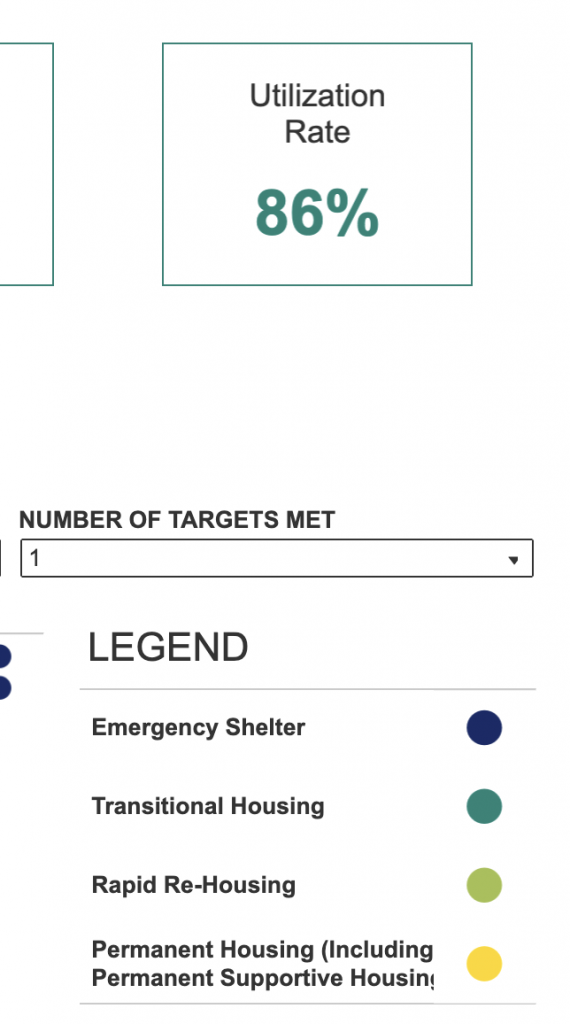
In 2025, LIHI-run tiny home villages had a 90% occupancy rate, and it wasn’t higher only due primarily to unoccupied nights as residents turned over, or as a village was being wound down to prepare for a move. Regardless, 90% just beats the 86% utilization rate for all emergency shelters system-wide in 2025, as measured by the KCRHA.
Also, the city of Seattle’s Unified Care Team (the outreach folks at Seattle’s Human Services Dept.) produced a report for Q3, 2023 (see pg. 6) that detailed reasons why folks in encampments declined an offer of shelter, even when their encampment was being swept. The number one reason, cited 23% of the time? “Wants a tiny house.” Data like this implies that tiny homes are the most desired form of non-congregate shelter.

Most Successful …
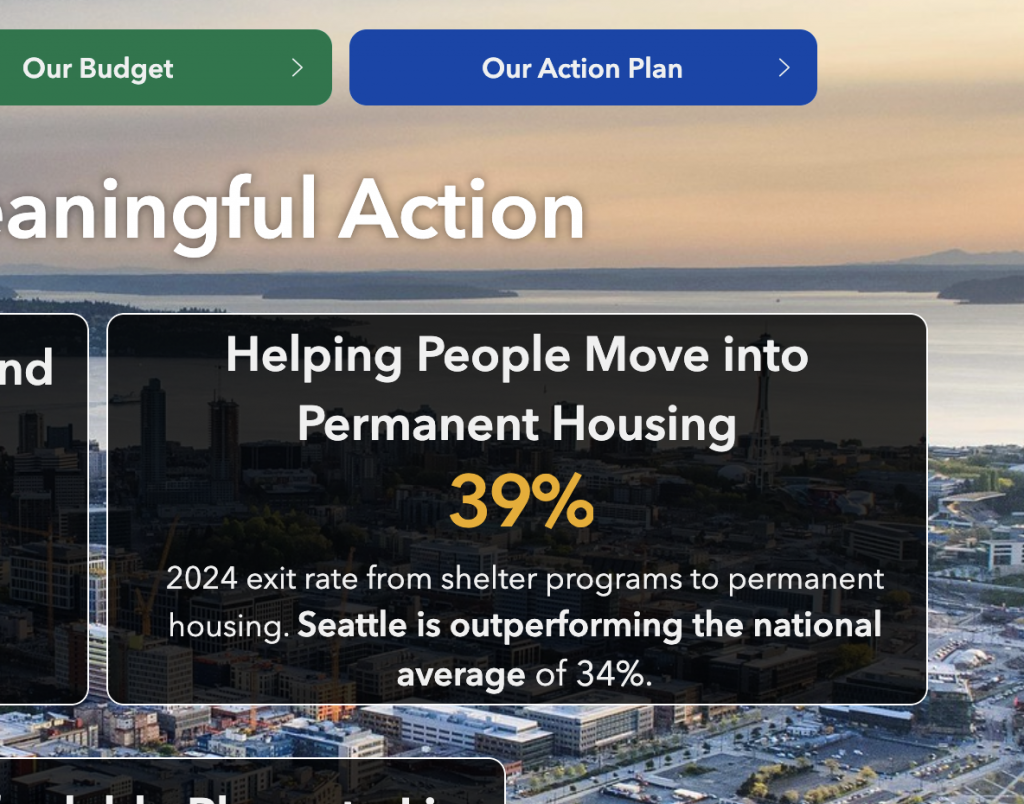
In 2025 55% of LIHI tiny home village residents who left the village, moved into housing — either a permanent home like an apartment, or a specialized housing situation like an assisted living facility, adult family home, or nursing home. According to the city’s One Seattle Homelessness Action Plan website, 39% of all folks in shelters in Seattle moved to permanent housing in 2024, and 34% of those nationwide did so. So the services that residents receive while living in a tiny home village are helping them move out to housing at a higher rate compared to all shelter types – and helping them stay there. Tiny homes and villages don’t just move folks off the streets, they help them end the cycle of homelessness for good AND in doing so, they help stop the sweeping of encampments from one neighborhood to another that does nothing to solve the problem and costs millions of dollars per year.

Most Affordable …

We build each of our tiny homes with all-volunteer labor and just $4500 worth of construction materials. Once the cost of village infrastructure is added, including hygiene trailers, community kitchen, laundry building, staffing, and security, the cost per tiny home to build it, install it, and have the village ready for move-in is roughly $28,000 per home depending on the size of the village and how many homes the infrastructure cost is being shared across. Nevertheless, the cost to build an apartment building in Seattle typically ran $300k-$400k per unit during 2024-25. And another popular option, buying unused hotels for housing (as with King County’s Health Through Housing Initiative), reported acquisition costs of $148k to $363k per unit (see pg. 54). Tiny homes and their villages are certainly a bargain comparatively.

With the above data to back us up, we can confidently say that tiny homes and villages are the most desired, most effective, and most affordable alternative to tents and encampments!

Do Tiny Home Villages Allow Drug Use?

Social media posts by the local Seattle “action-based, boots-on-the-ground movement,” We Heart Seattle, falsely imply that tiny home villages are merely taxpayer-funded drug dens. For instance, in the video the interviewer says, “do you know that the tiny house villages [our emphasis] have a dedicated tiny home, built by volunteers, to be used as a fentanyl smoking shack. . . ?” This is untrue. While this particular village does seem to have one, “tiny house villages”, plural, implies every one of them does, which is not true.

Nearly all tiny home villages in the Seattle area are clean and sober but a few are not. This is what’s known as the “low-barrier” approach to shelter – get people inside and off the streets, without requiring them to be clean first, then try to convince them to accept offered MAT – medically assisted treatment. Delivering methadone or buprenorphrine to folks who have a fixed location, or offering the new long-acting buprenorphine treatment, is a lot more successful than asking them to get to a mobile van or clinic every day or once a week – or demanding they go “cold turkey”.

This is a basic and long-standing debate about abstinence vs. harm reduction strategies for drug use and how to treat it. This has Nothing. Zero. to do with tiny homes and villages but this organization seems to have an opinion about them and is using behavior they KNOW will outrage viewers and attaching it to tiny homes in general to discredit them.

a homeless tent encampment crowds a sidewalk

The volunteers that give their time with this group to clean up trash and restore public spaces to usable conditions deserve all credit and thanks for pitching in. Their documented efforts are impressive. But broad generalizations about ALL tiny home villages, ALL shelters, or ALL homeless people only hurt efforts to move people off the street – which should be a goal we can all agree on, right?

For more information on addiction and mental health issues among the homeless population, see this article on AmericanAddictionCenters.org or this September, 2025 research from the non-partisan, health-policy research group, KFF .

Are Tiny Homes Sitting Unused in Storage?

Be sure to read the August, 2025 & March, 2026 Updates, below

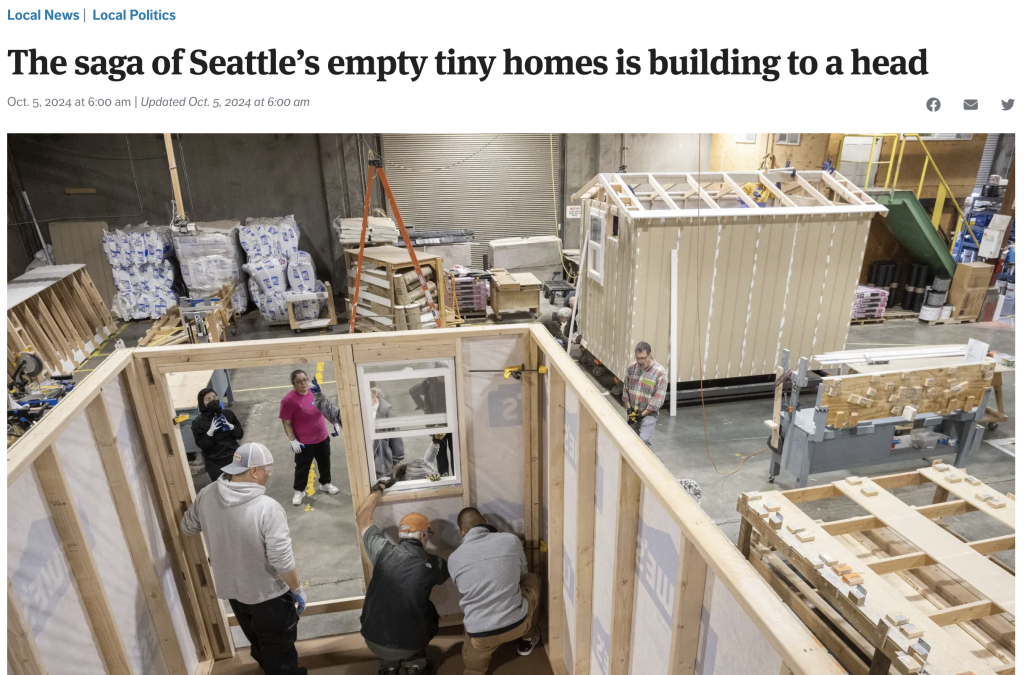
An October 5, 2024 column in The Seattle Times by Danny Westneat, “The saga of Seattle’s empty tiny homes is building to a head” highlighted the absurdity of more than 200 of our tiny homes sitting in storage, unused, while more than 9800 of our homeless neighbors sleep in tents, encampments, and rv’s. To cap it off, the writer included the incident of a homeless woman breaking into one of our homes in our back storage area, locking herself inside, and sleeping in there for two nights. So yes, in the Fall of 2024, with the numbers of our fellow Seattleites who are homeless increasing every year, we had over 200 finished tiny homes in storage, waiting to shelter a neighbor who was otherwise on the streets and help them along the way to permanent housing. Bureaucracy can be maddening.

But things have dramatically improved . . . keep scrolling!

UPDATE: August, 2025 – the situation has improved considerably

After just one village opening in 2023-24, there have been three openings in 2025 (Eagle Village 2.0 in March, Rosie’s Village 2.0 and Kingfisher Village both in July) and at least two more villages are announced for Seattle as of August. As we predicted last Fall, village openings do not happen with regularity but rather tend to happen in waves. As village sites are ready we need to be able to provide typically between 40-65 homes all at once. Our past experience is that, sooner or later, bureaucracy unsticks and more villages are built – and we’re going to continue to be ready when that happens.

Supporting any non-profit is a personal choice.  We respect your decision no matter what it is.  Most importantly, we celebrate your commitment to be a part of the solution in the past, present, and future with your donations, your time commitments, and your word-of-mouth sharing of the tiny home solution with family, friends, and colleagues. HOMELESSNESS IS SOLVABLE!  Over the years, we have overcome many challenges and we seem to finally be moving beyond this one too. 

UPDATE: March, 2026 – Finally, up to TEN more villages!

After an 18-month bottleneck deploying our tiny homes in the region, four villages opened in 2025, three in Seattle plus one in Tacoma. A fifth village opened this month in Tukwila, a sixth called Glassyard Commons was just announced for Seattle, and two more villages are currently under construction in Spanaway and Tukwila. Finally, up to two more villages are also planned for 2026 for a TOTAL OF UP TO TEN VILLAGES in 2025-26. Taken altogether, NEARLY 500 TINY HOMES will be deployed in these ten villages within roughly 24 months.

photos of the four tiny home villages that opened in 2025

Thank you for your ongoing confidence in tiny homes as we work to implement our Three-Year Plan to put a roof over the head, and a lock on the secure front door, of every homeless neighbor who wants one by the end of 2027. You can help by volunteering or donating to buy materials. Hope to see you at The Hope Factory!

What are tiny home “villages”?  Does Sound Foundations NW operate the tiny home villages?

LIHI’s Riverton Park Village, Tukwila
aerial photo of Raven tiny home village, a solution to homelessness in Ballard, Seattle
Chief Seattle Club’s Raven Village, Ballard, Seattle

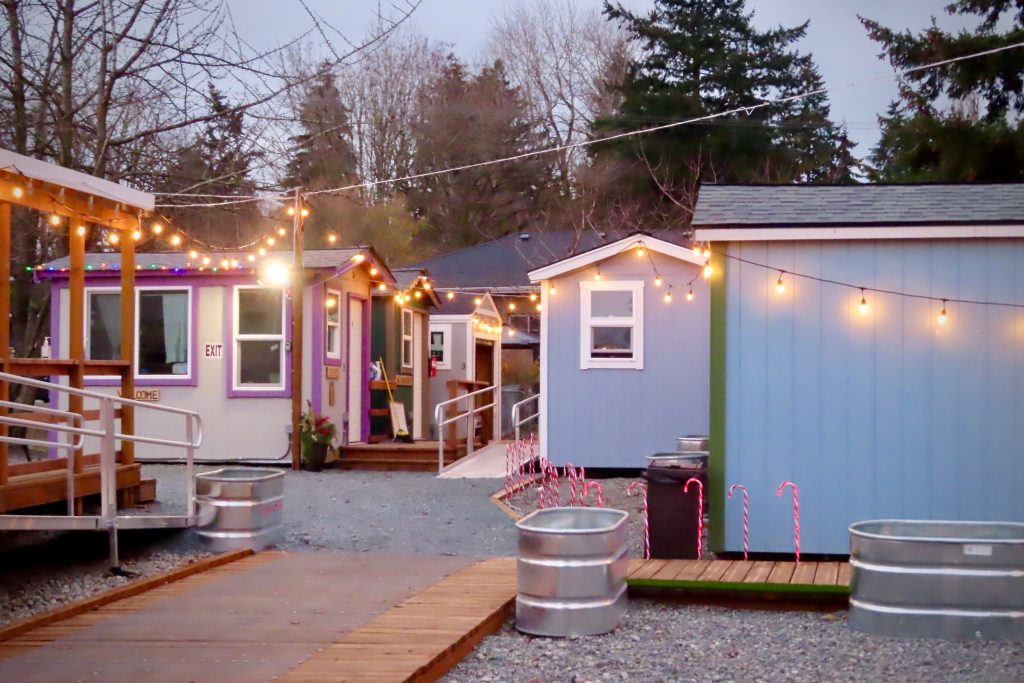
We build the tiny homes but no, we do not locate, staff, or operate the villages. When the finished tiny homes leave our warehouse, we transfer them to one of our affiliated service provider agencies, like the Low Income Housing Institute (LIHI), Chief Seattle Club, or others, who cluster the homes in pre-approved, staffed, and secure sites, called villages. Villages also offer communal restroom/ shower facilities, community kitchens & laundry, security fencing, social services, and 24/7 staffing. See a map of village locations here.

As much as anything, homelessness is about a lack of COMMUNITY.  Tiny home villages help residents create community among themselves and stabilize and rebuild trust after the instability of being homeless. And, the supportive services that are offered in villages help residents to address the problems that led to their homelessness in the first place and permanently break the cycle of homelessness. In 2025, 98% of tiny home village residents in LIHI-run villages who had moved into permanent housing, were still housed one year later. Tiny homes and villages don’t just move folks off the streets, they are one of the most successful long-term solutions to homelessness.

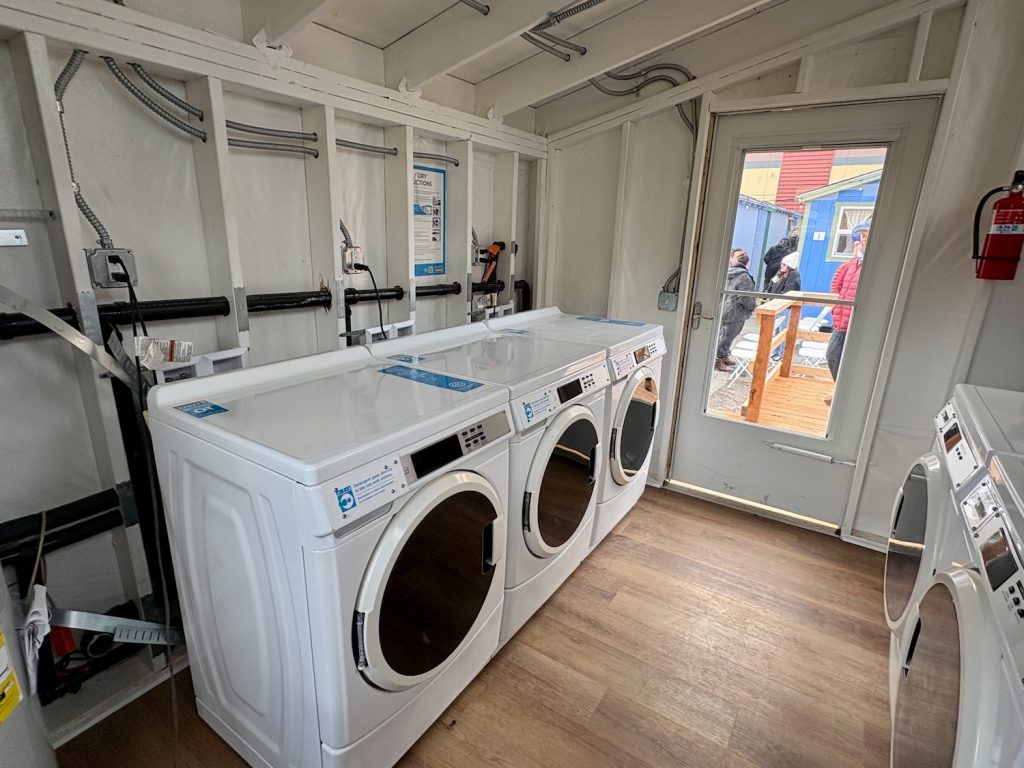
the community laundry at Olympic Hills Village, Seattle
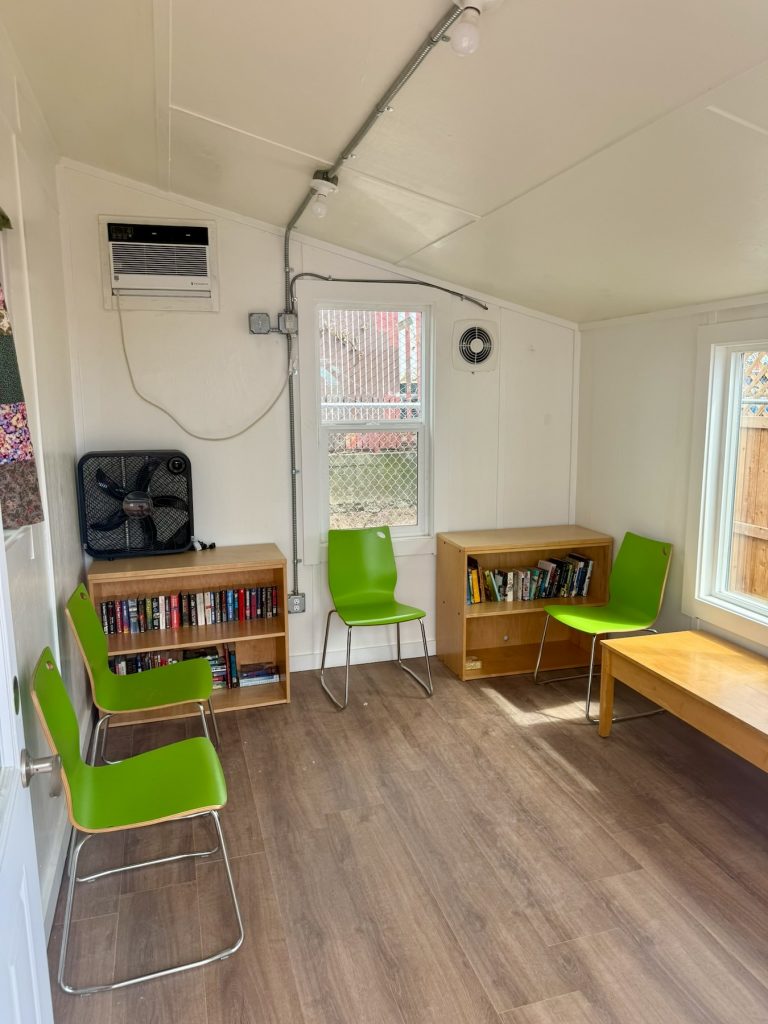
a tiny home village community room in Seattle
a community multi-purpose room at Rosie’s Village 2.0, Seattle

Are there services available in tiny home villages?

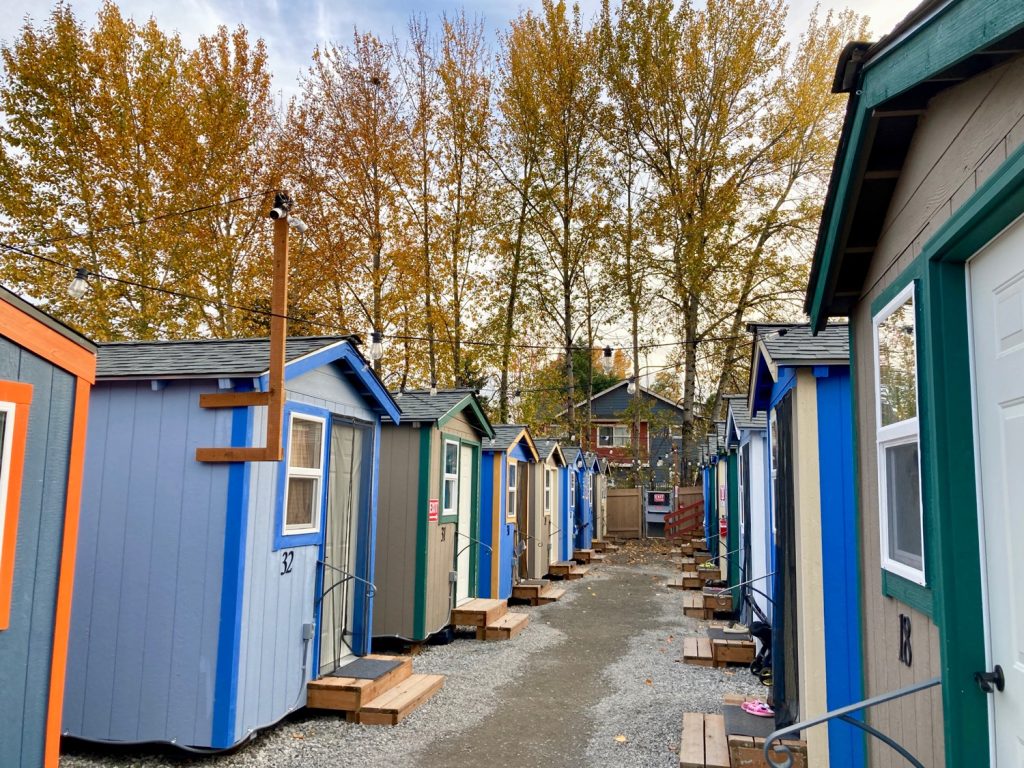
photo of Henderson tiny home village in Seattle, featuring tiny homes built by sound foundations nw, a nonprofit builder of tiny homes for the homeless

Absolutely.  In the villages, trained case managers help residents with tasks like document replacement and registration for benefits, educational and job training opportunities, referrals for medical treatment or counseling services, and even for addiction treatment.  These supportive services, combined with a safe and stable place to live and plenty to eat, helped roughly 55% of tiny home village residents move to some form of housing in 2025 – a rate far higher than almost every other shelter model. And because residents have help addressing the issues they need to address to move beyond homelessness while still in the villages, 98% of those who move to permanent housing are still housed one year later.


Aren’t tiny homes for the homeless just glorified shacks or shantytowns?

Absolutely not.  Our tiny homes are dignified and durable structures, offer security and privacy, and are architect-designed to last at least twenty years.  Our homes have heat & air conditioning, electricity, operable windows, and a locking door for both privacy and security.  Services available to residents include document, educational, and other administrative support, restrooms and showers, food and cooking facilities, medical and dental referrals, even referrals for addiction treatment. We know it’s not a permanent solution, but there must be alternatives to living on the ground, under the highway, or in a car, sometimes for years, AND ALSO a long-term strategy for more permanent and affordable housing.

Tiny homes and their villages are the most requested, most successful, and most affordable solution to unsheltered homelessness.

interior tiny home photos from the opening of Raven Village, the newest tiny home village for the homeless in Seattle's Ballard neighborhood
Tiny Home interiors are finished, comfortable, and secure

Isn’t it cruel to force someone to live in a tiny house?  Why don’t we just build more affordable housing?

In a perfect world, that would be the best solution.  But in reality, it takes 3-7 years to purchase a property, design a building, do neighborhood outreach, and build and occupy the building. Meanwhile, nearly TEN THOUSAND of our fellow citizens languish on the streets. Many people without homes are on wait lists for permanent housing for years.  In the meantime, their only options include living in tents, RV’s, and encampments – and THAT’s cruel.

Building tiny homes and villages is an inexpensive, scalable, and achievable homelessness solution to get our homeless neighbors off the ground, out of the tents, and into a safe, secure, and dignified space until permanent affordable housing can be obtained.

Tiny home villages had a 90% occupancy rate in 2025, making them by far the most desired shelter type by those who need it.

side-by-side photo showing tiny homes for the homeless as a solution to homelessness vs. a tent encampment in Seattle's SODO neighborhood

How many tiny homes for the homeless are there in Seattle?

As of Spring, 2026, there are 19 tiny home villages in Western Washington that use tiny homes built by Sound Foundations NW, plus four more in progress and several more in the planning stages. You can find a map of village locations here.  On average, there are about 40 tiny homes per village, meaning there are approximately 750 tiny homes currently operating around Puget Sound.

tiny homes for the homeless shown in the snow at Camp Second Chance in seattle, tiny homes are a temporary solution to homelessness