
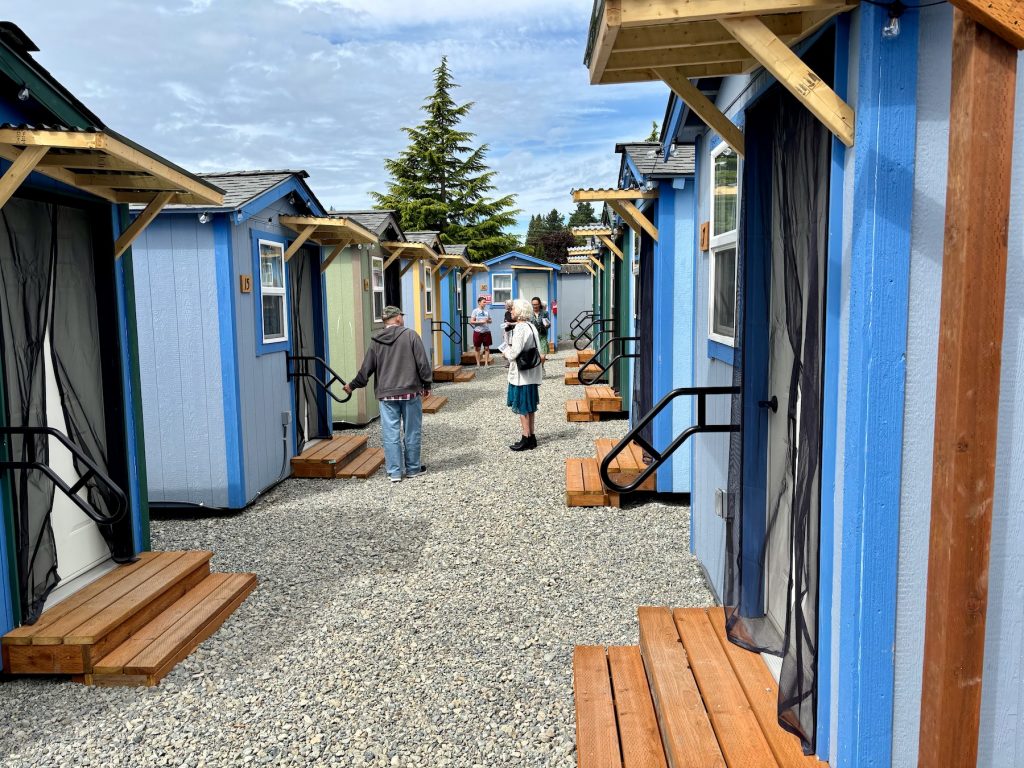
What is a tiny home for the homeless? Why do we need them?

a tiny home village for formerly homeless folks in seattle

Every night in Seattle/King County, WA, more than 9800 people sleep on the streets or in vehicles, according to the 2024 Point-in-Time Count.  That’s a 27.7% increase in unsheltered folks in just two years. There is a tremendous and immediate need for desirable, indoor alternatives, especially non-congregate options.

Tiny homes are small structures built as temporary alternatives to living outside, so that our homeless neighbors aren’t sleeping in leaky tents, muddy encampments, unsafe vehicles, or abandoned buildings while they await permanent housing.  Tiny homes are not permanent housing and are not an alternative to building more permanent affordable housing.  Rather, they are private, non-congregate, transitional shelter that allows our homeless neighbors to live inside where it’s warm, safe, and dry while they stabilize in a village with support from professional staff to help move them to the next step in their lives. 

Why are tiny homes a good solution to homelessness?

infographic showing tiny homes for the homeless are 3x as effective at solving homelessness in seattle area vs traditional group shelter

Tiny homes are a quick, scalable, affordable, and desirable alternative to citizens living on the streets.  Non-group (or, “non-congregate”) shelter options, like tiny homes and refurbished hotels & motels, where people have their own key and a place to secure themselves and their belongings, are generally much more desired by folks who are otherwise homeless than are traditional group shelters.

We build tiny homes for a small fraction of the cost of other non-congregate shelter options.  And in 2025 according to LIHI, the supportive services that come with living in a tiny home village were successful roughly 55% of the time at moving residents into permanent housing and breaking the cycle of homelessness.  That’s one of the highest placement rates in the country.

Why doesn’t the city, state or federal governments pay for the tiny homes?

a homeless tent encampment crowds a sidewalk

Unsheltered homelessness is a symptom of many other complex problems including lack of affordable housing or temporary shelter space, unanticipated expenses, job loss, untreated mental illness and addiction, even family estrangement. Lots of agencies within each level of government ARE trying to find solutions to the homelessness crisis.  Tiny homes are one solution to temporarily solve the problem, but funding is finite.

Tiny homes are relatively inexpensive, durable, scalable, and most importantly desired by the folks who need shelter. They are intended to provide temporary housing until other, longer term solutions made by governments and other agencies can be achieved.  Sound Foundations NW has received some grants from the City of Seattle and Washington State, but over 90% of our donations come from individuals, businesses, and private foundations.

Isn’t it cruel to force someone to live in a tiny house?  Why don’t we just build more affordable housing?

In a perfect world, that would be the best solution.  But in reality, it takes 3-7 years to purchase a property, design a building, do neighborhood outreach, and build and occupy the building. Meanwhile, nearly TEN THOUSAND of our fellow citizens languish on the streets. Many people without homes are on wait lists for permanent housing for years.  In the meantime, their only options include living in tents, RV’s, and encampments – and THAT’s cruel.

Building tiny homes and villages is an inexpensive, scalable, and achievable homelessness solution to get our homeless neighbors off the ground, out of the tents, and into a safe, secure, and dignified space until permanent affordable housing can be obtained.

Tiny home villages had a 90% occupancy rate in 2025, making them by far the most desired shelter type by those who need it.

side-by-side photo showing tiny homes for the homeless as a solution to homelessness vs. a tent encampment in Seattle's SODO neighborhood