Why Do You Call Tiny Homes the, “most desired, most successful, and most affordable” solution?

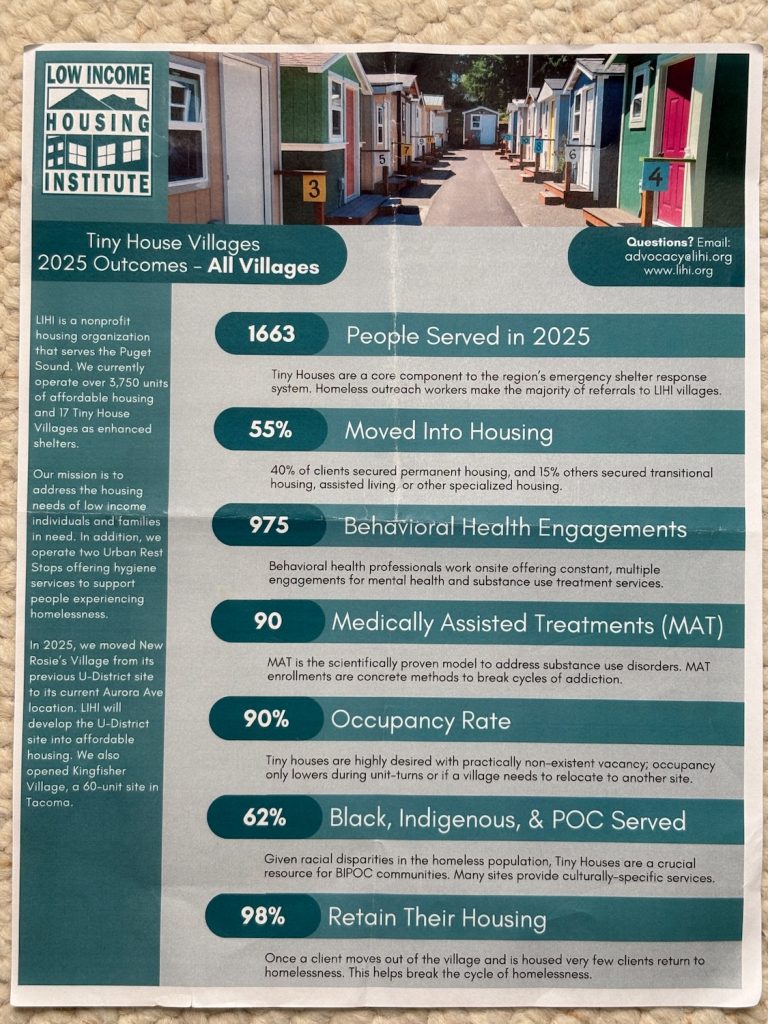
Since most of the tiny home villages in our area are run by the Low Income Housing Institute (LIHI), and most of the tiny homes in LIHI’s villages are built by Sound Foundations NW, we rely on the annual data they produce regarding outcomes for their tiny home villages to evaluate our homes’ performance.

Most Desired …

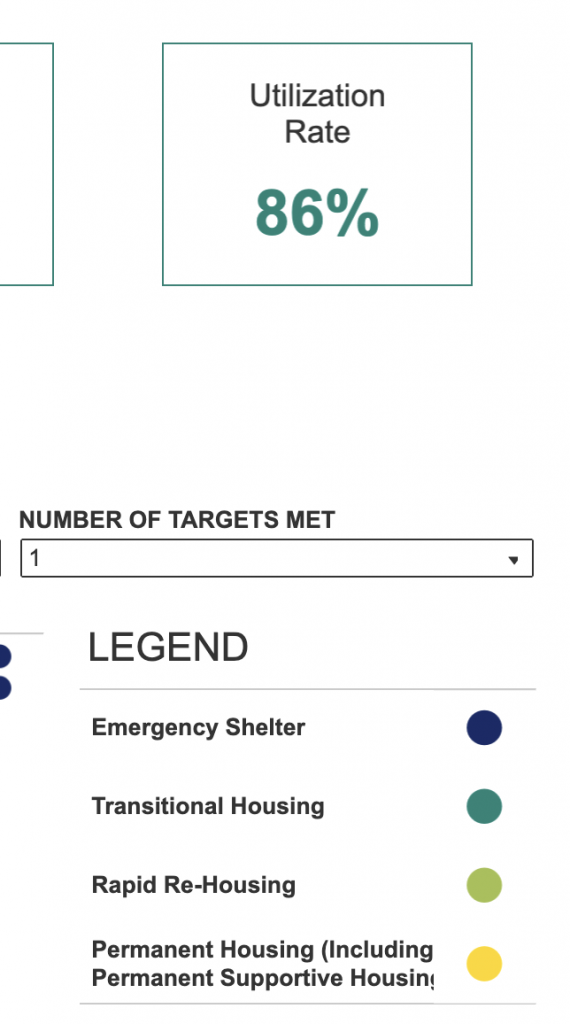
In 2025, LIHI-run tiny home villages had a 90% occupancy rate, and it wasn’t higher only due primarily to unoccupied nights as residents turned over, or as a village was being wound down to prepare for a move. Regardless, 90% just beats the 86% utilization rate for all emergency shelters system-wide in 2025, as measured by the KCRHA.
Also, the city of Seattle’s Unified Care Team (the outreach folks at Seattle’s Human Services Dept.) produced a report for Q3, 2023 (see pg. 6) that detailed reasons why folks in encampments declined an offer of shelter, even when their encampment was being swept. The number one reason, cited 23% of the time? “Wants a tiny house.” Data like this implies that tiny homes are the most desired form of non-congregate shelter.

Most Successful …
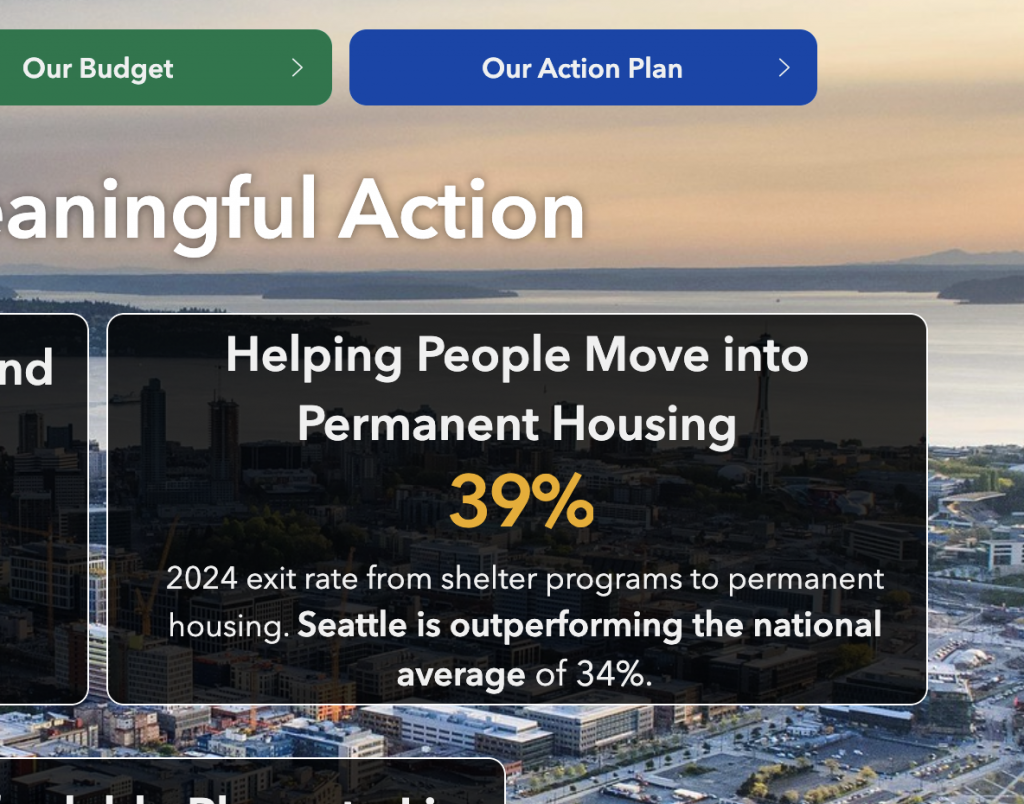
In 2025 55% of LIHI tiny home village residents who left the village, moved into housing — either a permanent home like an apartment, or a specialized housing situation like an assisted living facility, adult family home, or nursing home. According to the city’s One Seattle Homelessness Action Plan website, 39% of all folks in shelters in Seattle moved to permanent housing in 2024, and 34% of those nationwide did so. So the services that residents receive while living in a tiny home village are helping them move out to housing at a higher rate compared to all shelter types – and helping them stay there. Tiny homes and villages don’t just move folks off the streets, they help them end the cycle of homelessness for good AND in doing so, they help stop the sweeping of encampments from one neighborhood to another that does nothing to solve the problem and costs millions of dollars per year.

Most Affordable …

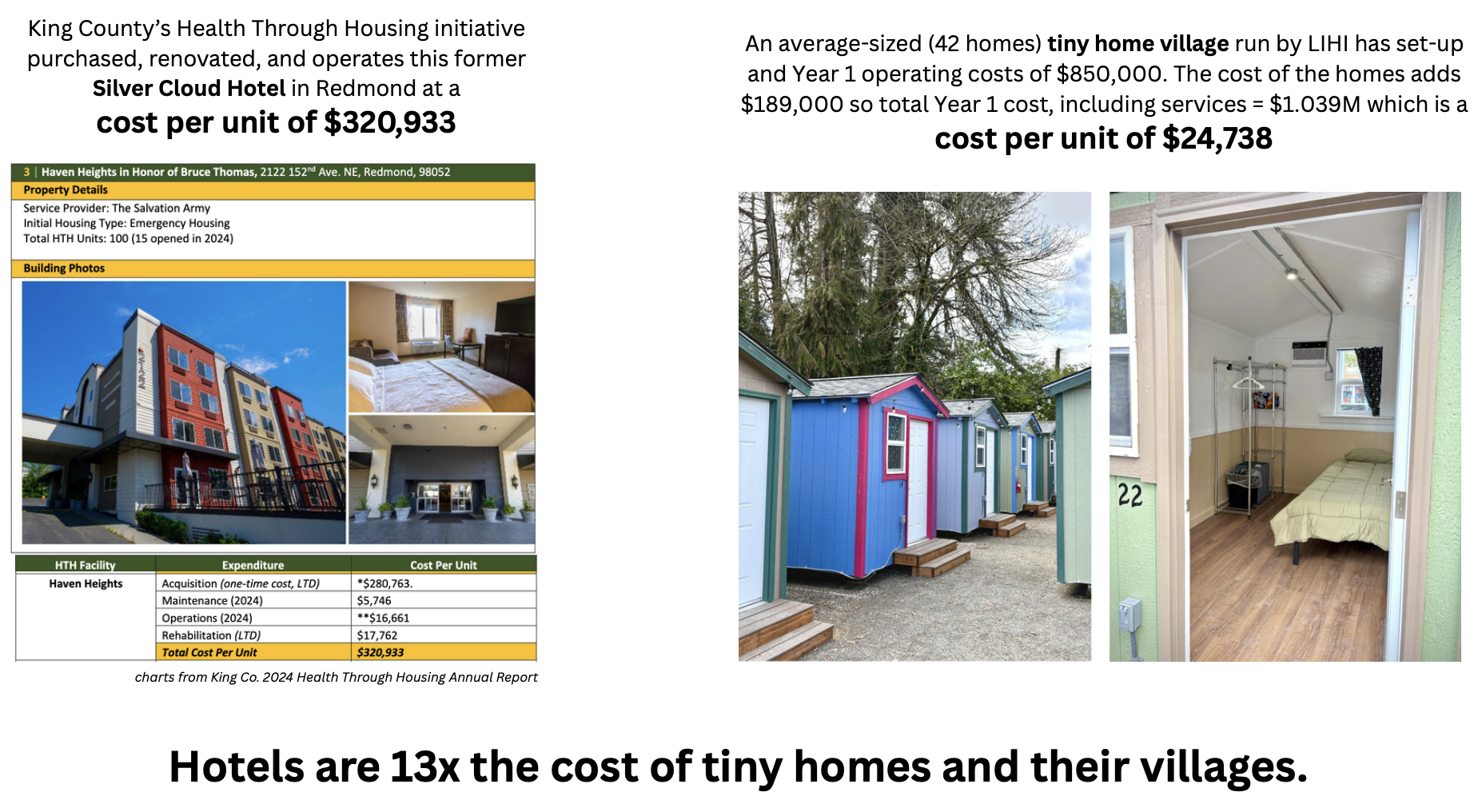
We build each of our tiny homes with all-volunteer labor and just $4500 worth of construction materials. Once the cost of village infrastructure is added, including hygiene trailers, community kitchen, laundry building, staffing, and security, the cost per tiny home to build it, install it, and have the village ready for move-in is roughly $28,000 per home depending on the size of the village and how many homes the infrastructure cost is being shared across. Nevertheless, the cost to build an apartment building in Seattle typically ran $300k-$400k per unit during 2024-25. And another popular option, buying unused hotels for housing (as with King County’s Health Through Housing Initiative), reported acquisition costs of $148k to $363k per unit (see pg. 54). Tiny homes and their villages are certainly a bargain comparatively.
With the above data to back us up, we can confidently say that tiny homes and villages are the most desired, most effective, and most affordable alternative to tents and encampments!

What is a tiny home for the homeless? Why do we need them?

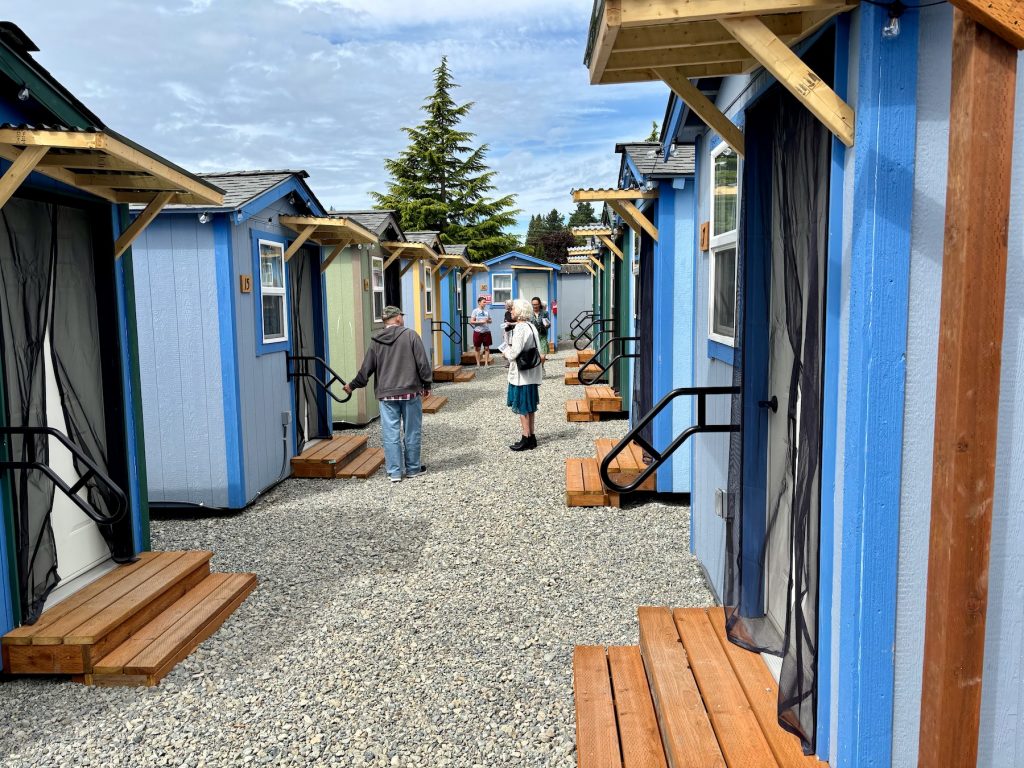
a tiny home village for formerly homeless folks in seattle

Every night in Seattle/King County, WA, more than 9800 people sleep on the streets or in vehicles, according to the 2024 Point-in-Time Count.  That’s a 27.7% increase in unsheltered folks in just two years. There is a tremendous and immediate need for desirable, indoor alternatives, especially non-congregate options.

Tiny homes are small structures built as temporary alternatives to living outside, so that our homeless neighbors aren’t sleeping in leaky tents, muddy encampments, unsafe vehicles, or abandoned buildings while they await permanent housing.  Tiny homes are not permanent housing and are not an alternative to building more permanent affordable housing.  Rather, they are private, non-congregate, transitional shelter that allows our homeless neighbors to live inside where it’s warm, safe, and dry while they stabilize in a village with support from professional staff to help move them to the next step in their lives. 

How large are the tiny homes?  Do they have heat and electricity?  What about running water?

Our tiny homes are 8 ft. x 12 ft., roughly the size of an apartment-sized bedroom, and are equipped with a bed, linens, standing closet, and other necessities.  Once they leave The Hope Factory for the villages, they are wired for electricity and are given an overhead light, wall outlets, a space heater, and an a/c unit.  The villages provide community spaces, shared bathrooms with hot showers and flushable toilets, and a community kitchen, laundry facility, and pantry.

interior tiny home photos from the opening of Raven Village, the newest tiny home village for the homeless in Seattle's Ballard neighborhood

How long does it take to build a tiny home for the homeless?

volunteers building tiny homes for the homeless, a fast and affordable solution to ending homelessness in seattle

Our jig system and assembly line style building process allow us to work on multiple homes at a time in our 15,000 square foot building facility.  To build and assemble four walls and the roof framing takes an inexperienced group a single day.  A team of experienced volunteers can frame two homes in a day.  The remaining steps, including insulation, interior wall & ceiling panels, flooring, roofing, interior & exterior trim, and interior & exterior paint, require about two weeks from start to finish.  At a moderate and consistent pace, we finish 3-4 homes per week.

a row of four nearly complete tiny homes for the homeless at Sound foundations nw, a non-profit builder

How do you build your tiny homes for the homeless?

Our tiny homes are architect-designed and volunteer-built to last 20 years.  They are wood framed construction, fully insulated, painted, and roofed with standard asphalt shingles.  They also have durable Pergo-style flooring, two operable windows, and a locking front door for residents’ privacy and security.  Our homes are built on a jig system which are basically very large templates, that allow even those with no construction experience to build one.  Plans for our entire construction system, including architectural drawing for the jigs, materials lists, cut lists, and assembly steps are available for free to any nonprofit or government agency that would like them.  Email soundfoundationsnw@gmail.com to inquire.

How much does a tiny home cost? How does that compare with other solutions?

Our tiny homes currently cost about $4500 ea. worth of materials to build (Spring, 2026).  We keep costs so low because we use a nearly 100% volunteer building crew.  About 85% of our expenses go directly to buying building materials and supplies.  The largest operator of tiny home villages, LIHI, reports average Year 1 infrastructure costs to install and run a 42-home village, of roughly $850,000. That means total construction, set-up, and Year 1 operations costs of $24,738 per tiny home.

By comparison, King County purchases underused hotels and refurbishes them as transitional shelter through its Health Through Housing Initiative. Their 2024 Annual Report cites a one-year rate for acquisition and remodeling of $298,525 per unit (acquisition + rehab/ remodeling).  Other factory-built shelter providers of pre-fab tiny home structures charge 4x-10x more than our homes cost to build.

We don’t disagree that ALL new shelter is good shelter, regardless of its origin. However, faced with a growing homeless population that’s not being matched by growing resources, we strongly believe in our tiny homes as the most affordable and therefore most scalable solution.

Do you accept donations to help build tiny homes for the homeless?

donate to help build tiny homes for the homeless, a solution to homelessness, in Seattle

Yes, thank you!  Our building materials are all purchased, not donated, although we do receive volume discounts.  More than 90% of our funding comes from individual, corporate, and foundation donations, and we welcome any financial assistance you can offer.  To donate by check, credit/debit card, direct bank transfer, your Donor Advised Fund or from your IRA, even appreciated stock or cryptocurrency, please click the blue donation button, go to our donation page, or contact our Development Director at devel.sfnw@gmail.com .

Graphic showing $4500 cost of building materials at Sound Foundations NW, a non-profit builder of transitional tiny homes as a solution to homelessness in Seattle

Aren’t tiny homes for the homeless just glorified shacks or shantytowns?

Absolutely not.  Our tiny homes are dignified and durable structures, offer security and privacy, and are architect-designed to last at least twenty years.  Our homes have heat & air conditioning, electricity, operable windows, and a locking door for both privacy and security.  Services available to residents include document, educational, and other administrative support, restrooms and showers, food and cooking facilities, medical and dental referrals, even referrals for addiction treatment. We know it’s not a permanent solution, but there must be alternatives to living on the ground, under the highway, or in a car, sometimes for years, AND ALSO a long-term strategy for more permanent and affordable housing.

Tiny homes and their villages are the most requested, most successful, and most affordable solution to unsheltered homelessness.

interior tiny home photos from the opening of Raven Village, the newest tiny home village for the homeless in Seattle's Ballard neighborhood
Tiny Home interiors are finished, comfortable, and secure

I’d like to volunteer to build a tiny home for the homeless, do I need construction experience?

Absolutely not, no experience required!  All you need is a willing heart, and we will teach you the rest.  Our homes are built on a jig system which are very large templates that allow even those with no construction experience an easy and efficient way to help build a home. See here for more information on volunteering.

As a newer volunteer you’ll be paired with someone with more experience who will help you build on a tiny home the very first day.  Our volunteers range in age from 16 to 96!  There’s always something to do regardless of your age or ability level, but for safety reasons we do require all volunteers be at least 16 years old.

volunteers building tiny homes for the homeless at sound foundations nw, a nonprofit builder in seattle
volunteers at sound foundations nw a nonprofit builder of tiny homes for the homeless

My company, social, church, or other group is looking for a group volunteer day. Can my group build tiny homes for the homeless?

Absolutely!  Building a tiny home is a really meaningful way for your team to come together to make a local impact.  We accept groups of up to 10 people (12 in a pinch) at a time and have hosted groups from Amazon, Microsoft, Google, T-Mobile, and Boeing at one end of the company scale, and local real estate offices, churches, small law firms, and even scout troops at the other.

Your group will start with a short tour of our facility, called The Hope Factory.  Then, depending on the work needed that day, you could either be starting a new tiny home or else helping finish existing homes.  Either way, you’ll be making a difference!

As part of your experience, you will also learn about the human side of homelessness and how tiny homes make an impact as part of the solution.  For groups of six or more, we do require advance bookings.  We plan our group availability up to three months in advance, and the dates fill up quickly.  To ask about availability, please email soundfoundationsnw@gmail.com. Groups of five or fewer may simply sign up as individuals on the weekly sign up. For more info on volunteering, see our Volunteer page.